


What could AI help your WordPress website become?
Author: Dan Clark 9th Jul 2026 15 minutes read

Overview
Every significant digital innovation eventually changes much more than people first expect.
Ecommerce wasn’t really about shopping baskets. It changed how businesses sold products and what people expected from the buying experience. Faster delivery, greater convenience and more choice have quickly become the norm. Mobile wasn’t simply about smaller screens. It changed how we interact with digital services every day.
We think AI belongs in that same category.
At the moment, however, much of the conversation focuses on the most visible examples. AI chatbots. AI search. AI-generated content. New plugins promising to transform websites in a few clicks. Those developments are interesting, and many will undoubtedly become part of everyday web development, but they also risk becoming shorthand for something much bigger.
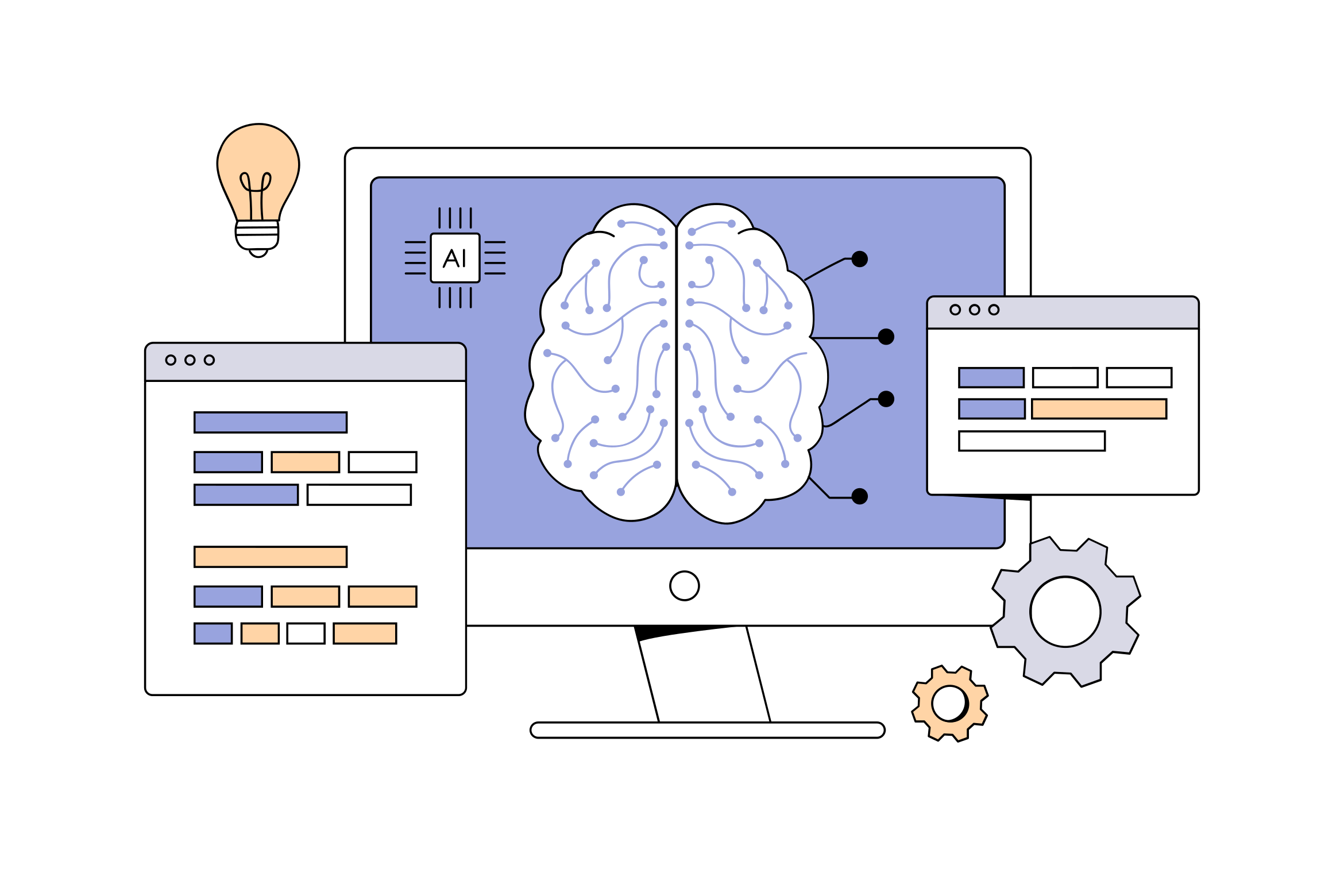
The more interesting question isn’t what AI features a website might have. It’s whether AI changes what a website is capable of becoming.
Beyond the digital brochure
For years, websites were treated as digital brochures. Their job was to present information, explain what a business did and encourage somebody to get in touch. Good design, clear content and an easy way to make contact were often enough.
Those things still matter, but they’re no longer enough on their own.
Today’s websites help people complete applications, book appointments, buy products, access services, manage memberships and find information. Behind the scenes, they connect with CRMs, marketing platforms, finance systems and countless other tools that help organisations operate more effectively. In many cases, the website has become just as useful to the people working within the organisation as to those visiting it.
That’s why we’ve never really thought of WordPress as just a content management system. We’ve always seen it as a platform for building business solutions.
Sometimes that means creating bespoke editorial workflows. Sometimes it’s integrating systems that have never spoken to one another before. Sometimes it’s building functionality that just doesn’t exist because no off-the-shelf plugin quite fits what the organisation is trying to achieve.

Technology has never been the starting point. Understanding how a business works comes first because that’s where the real opportunities usually reveal themselves. Once you understand the people, the processes, and the challenges they’re trying to overcome, designing the way things flow becomes much easier.
That’s always been the part that really excites us – understanding how an organisation works, recognising where technology can make life easier and then building something that genuinely helps people work more effectively.
AI isn’t another plugin
It’s tempting to assume AI should follow the same path as almost every other WordPress feature.
Need online forms? Install a plugin. Need ecommerce? Install a plugin. Need SEO? Install a plugin. Need AI? Install another plugin.
WordPress has always benefited from an extraordinary ecosystem of plugins, so that line of thinking is entirely understandable – if not a cause for potential problems.
With AI, the difficulty is that it’s not just another feature waiting to be switched on.
Connecting WordPress to an AI model is becoming much easier. APIs are more accessible than ever, and new services appear almost weekly, each offering another way to integrate AI into a website. From a purely technical standpoint, establishing that connection is rapidly becoming the easiest part of the process.
The real work begins much earlier. It begins by understanding what the organisation actually needs its website to do.
Perhaps that’s helping an editorial team maintain thousands of pages more effectively. Perhaps it’s identifying issues before visitors encounter them, recognising patterns hidden within analytics or reducing repetitive administrative work that quietly consumes hours every week. In another organisation, it may involve bringing together information from several disconnected systems or helping staff make better decisions by using knowledge that’s already available but difficult to access.
None of those ideas begins with AI; they’re business challenges. AI simply becomes another capability that can help solve them.
Looking beyond the obvious
That’s probably why we’re more interested in the parts of AI that visitors may never notice.
Modern websites already have an enormous amount of knowledge about the organisations they support. They know how services, departments, audiences and content relate to one another. They know who can publish information, which content requires approval and how editorial workflows operate. They connect with customer relationship management systems, booking platforms, payment providers, analytics services and countless other parts of the organisation.
AI doesn’t replace any of that. It just has the potential to make it more useful. Once a website begins to recognise how information connects, how people work, and what the organisation is trying to achieve, AI stops looking like a standalone feature and starts becoming another part of how the website works.
We believe that’s where the biggest opportunities lie. Not in creating ever more impressive AI features, but in helping websites become more useful to the organisations behind them.
Supporting the people behind the website
Much of the public conversation around AI eventually arrives at the same place:
Can it write content? Can it answer questions? Can it replace part of somebody’s job?
They’re understandable questions because they’re the most visible examples of what AI can do. They also risk overlooking where many organisations are likely to see the greatest value.
Most teams aren’t struggling because they lack expertise. They’re struggling because experienced people spend an extraordinary amount of time on work that adds relatively little value. They review content that should already have been checked, search for information that ought to be easier to find, compare documents to make sure guidance remains consistent and gradually build an understanding of problems that have quietly developed over months or even years.
Those aren’t failures of people. They’re often limitations of the systems supporting them.
That’s one of the reasons we believe websites themselves have the potential to become much more active participants in the organisations they support.
Imagine an editor preparing to publish a new article. Rather than immediately generating content, the website begins reviewing what’s already there. It notices that another page covers a similar subject but reaches a slightly different conclusion. It identifies guidance that has recently changed elsewhere on the site, suggests links to related content, highlights accessibility improvements that could strengthen the page and points out terminology that’s inconsistent with the organisation’s editorial style.
None of those recommendations need to be accepted automatically. In many cases they probably shouldn’t be. Editorial responsibility still belongs with the people managing the website, because they’re the ones who understand the organisation, its audiences and the purpose behind the content they’re publishing.
What AI can do is reduce the amount of routine checking that eats up editorial time, allowing people to spend more of their energy on judgement rather than administration. That’s a much more interesting role than simply asking AI to create content from scratch, because it complements human expertise instead of attempting to replace it.
Websites shouldn’t wait for problems
The same principle goes well beyond publishing.
Every website changes over time because every organisation does. New services emerge, older information becomes less relevant, priorities shift and expand, and different teams contribute new content that reflects how they work.
Even the best managed websites gradually develop inconsistencies, not because somebody has done anything wrong, but because organisations are living systems rather than static documents.
Most organisations already understand that reality. The challenge is recognising those changes early enough to respond.
Today, most of those improvements rely on people noticing that something isn’t quite right. That might happen while editing a page, performing routine maintenance, or reviewing analytics. The process works, but it’s naturally reactive because somebody has to discover the issue before it can be addressed.
AI creates the opportunity for websites to become much more proactive.
Rather than waiting for somebody to notice that several pages now contradict one another, the platform could identify those inconsistencies as they emerge. It could recognise that visitors are repeatedly searching for information the website doesn’t currently provide, highlight content that hasn’t been reviewed for several years or identify accessibility issues introduced through everyday editing before they begin affecting users.

None of those capabilities are especially dramatic. Visitors may never know they’re happening.
From the organisation’s perspective, however, they represent something much more significant. The website is no longer acting solely as a place where information lives. It’s beginning to help the organisation look after that information, maintaining its quality and highlighting opportunities for improvement before they become larger problems.
That feels like an important change in thinking.
Websites accumulate knowledge
One of the less obvious opportunities lies in something many organisations already possess but rarely think about. Knowledge.
Over the years, websites quietly become repositories of expertise. Articles are written, policies grow, services expand, case studies are published and guidance is updated. New members of staff contribute their own experience while older content continues to provide valuable context. Gradually, the website becomes one of the organisation’s richest sources of institutional knowledge.
The difficulty is that accumulated knowledge often becomes harder to use as it grows.
People know the information exists somewhere, but not necessarily where. Similar guidance appears in different places because nobody realises it already exists. Valuable expertise becomes buried beneath years of publishing, while new projects begin without awareness of work that’s already been done elsewhere in the business.
Traditional search can only take you so far because it relies on people knowing what they’re looking for. AI has the potential to change that relationship.
Instead of simply retrieving documents, a website could begin recognising how knowledge connects across the website. It might identify overlapping guidance, surface expertise relevant to a completely different team, or recognise that existing content already answers questions being asked elsewhere. The value doesn’t come from AI producing new knowledge. It comes from helping organisations make better use of the knowledge they’ve already invested years creating.
That’s where we think the real opportunity begins. Understanding the knowledge held within a website isn’t the destination; it’s the starting point. Once a website has a richer understanding of the information it holds, that understanding can begin to improve search, recommendations, editorial workflows, administration and countless other parts of the platform. The result isn’t a single AI feature. It’s a website that’s simply better equipped to support the organisation behind it because the platform is working with a much deeper understanding of the information it already contains.
Perhaps that’s one of the more exciting possibilities. Rather than simply publishing information, websites could begin helping organisations understand the information they already have.
Intelligence begins long before AI
One of the biggest misconceptions is that intelligence starts with the AI itself.
We think it begins much earlier, with the way a website understands the organisation it represents. Imagine two organisations connecting to exactly the same AI service on their websites.
The first has spent years developing a clear content strategy. Services are connected through meaningful relationships, editorial standards are consistent, taxonomies have been carefully designed and responsibilities are well understood. Content is reviewed regularly because the website continues to develop alongside it.
The second has accumulated years of duplicated information, inconsistent terminology and disconnected content. Different departments describe the same services in different ways, ownership has gradually become unclear and the website reflects years of change rather than a coherent structure.
The results are unlikely to be the same, even though the technology is identical.
The difference isn’t the language model. It’s the platform supporting it. AI can only work with what the website already knows. If information contradicts itself, relationships haven’t been established, or content lacks structure, the AI has very little to work with. It can’t invent understanding where none exists.
For us, the opportunity has never been about adding another capability to a website. It’s about building websites that understand the organisations behind them well enough for every capability, including AI, to become more useful.
Understanding your organisation
One of the reasons we’ve always enjoyed working with WordPress is that every organisation presents a different challenge.
A university isn’t simply publishing course pages. It has relationships between faculties, departments, research groups, admissions, funding, events and student support, all of which influence one another in ways that aren’t immediately obvious from the homepage. A local authority isn’t simply listing services. Housing, planning, waste collection, licensing, environmental health and social care all overlap in ways that affect both residents and the people who deliver those services.
The same is true for charities, membership organisations, theatres, manufacturers and professional service firms. Every organisation has its own priorities, responsibilities and ways of working. Those differences are often where the most valuable opportunities lie, as they reveal how technology can genuinely support the organisation, rather than simply adding another feature to its website.
That’s why our projects rarely begin by asking what WordPress already provides. We start by understanding the organisation itself.
How does information move around the organisation? Who owns it? Which tasks consume time that could be spent more effectively elsewhere? Where are people repeating work because systems don’t communicate with one another? What knowledge already exists but isn’t being used as effectively as it could be?
Those questions are usually where the best ideas emerge. Once you understand how people work, how information flows and what the organisation is really trying to achieve, the technology becomes much easier to define. You’re no longer trying to fit the organisation around existing software. You’re designing a solution around the way it already works.
That’s one of the reasons AI is so exciting to us. It doesn’t replace that process or suddenly provide all the answers. It simply gives us another way to respond to what we’ve learned, allowing us to build solutions that would have been far more difficult, time-consuming, or expensive only a few years ago.
Building capability rather than collecting features
This is also why we’re cautious whenever AI is presented as a growing collection of standalone products.
There will undoubtedly be excellent AI chatbots. Search will become more intelligent, content generation will continue improving and new services will emerge that nobody is currently predicting. Many organisations will benefit from those tools and, used in the right way, they may become valuable parts of a modern website.
The bigger opportunity, however, lies in looking beyond individual features and asking what the organisation is actually trying to achieve.
One organisation may want to reduce the amount of repetitive editorial work required to maintain thousands of pages. Another might be looking for better ways to share knowledge across different departments, identify patterns hidden within user behaviour or bring together information from several disconnected systems so people can make better decisions more quickly.
Those kinds of challenges rarely have off-the-shelf solutions because every organisation works differently. They usually require thoughtful planning, bespoke development, integrations and carefully designed business logic, with AI becoming another capability within that wider solution rather than the solution itself.
That’s one of the reasons we’ve always found WordPress so compelling. It has never been interesting because of the features it includes by default. Its real strength is the freedom to understand a problem first and then build the right solution around the organisation, rather than asking the organisation to adapt to somebody else’s software.
We see AI in exactly the same way. It isn’t something that replaces that process. It’s another technology that expands what’s possible once the hard work of understanding the organisation has already been done. The real opportunity doesn’t lie in connecting a website to an AI model. It lies in what organisations choose to build once that understanding, and that capability, are in place.
What comes next
The technology will continue changing. The more interesting question is how organisations choose to use it.
New models will appear, WordPress will introduce new capabilities, and developers building beyond off-the-shelf solutions will continue to find new ways to put them to work. Every week seems to bring another announcement, another service or another feature that promises to change how websites are built and managed. Some of those ideas will become part of everyday web development. Others will disappear almost as quickly as they arrived.
What interests us isn’t predicting which features will last. It’s understanding where AI can genuinely help organisations work more effectively. That conversation rarely begins with AI itself. It begins by understanding the people who use the website, the information they rely on, the processes they follow, and the challenges they face every day. Once those things are understood, AI becomes much easier to apply because it’s responding to a clearly defined need rather than searching for a problem to solve.
That’s the difference between adding AI to a website and designing one that genuinely benefits from it.
Explore this further

What does an intelligent website actually look like?
Learn what an intelligent website looks like and how AI-ready content, connected systems and structured…


Modern website platforms: a complete guide
Learn what makes a modern website platform, including reusable content, connected systems, maintainability and planning…
How does AI understand your website?
Discover how AI systems process and interpret website content. Learn why building a clear, accessible,…

Future-proofing your website
Learn why future-proofing isn’t about predicting technology, but creating websites that are easier to maintain,…
